
.

.
 Wishing you all a Very Safe
.
*animation card ©joysofcreating
.
It got down to 27° last night.
It was the first heavy frost of the season and
it pretty much done-in most of the plants around here.
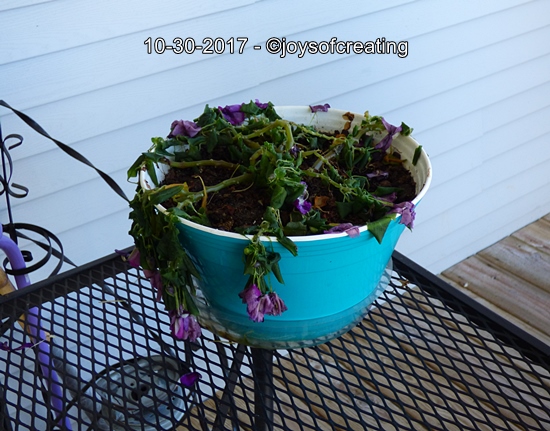
Wishing you all warmth during this frosty time of year.
.
 As it turns out, my mesh cover keeps out most of the insects, however there is one kind of insect that evidently was able to get through… the fruit fly or what we call a fruit fly.
I didn’t know that they were in the basil. Each evening when I’d bring the basil inside and set it on the window sill, unbeknownst to us, fruit flies would get out and fly around the house. We’d chase them down and kill them and wonder where they heck they came from. It wasn’t until I saw one inside the mesh of the basil container that I figured out where the little buggers was coming from and it all made sense. I figure they must’ve got on the soil and laid eggs. Yuck!
Since I didn’t want to toss my basil, I decided to use a little natural control on them.
I got out my bag of ‘Diamaceous Earth – Food Grade’ also called ‘DE’ and covered the soil heavily. As long as it stays dry, it’s effective against insects.
I’ve always watered the basil from the bottom tray. It helps keep the roots deeper in the soil. So, I’m good there.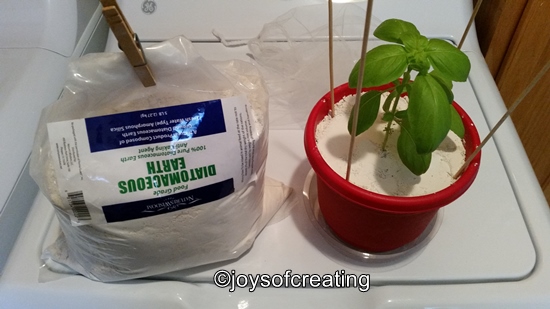 So far so good on keeping the fruit flies controlled.
‘Diamaceous Earth – Food Grade’ is a natural pest control. The way DE works is it scratches the spiders/insects/bugs exoskeleton and causes them to dehydrate and die.
If you plan to try ‘Diamaceous Earth’, make sure you use ‘Food Grade’. And also, do the research and read all you can about it. There’s safety measures that need to be followed if it’s used on a larger scale than I have used it here in my basil container.
I hope you all have a pest-free rest of the week!
.
We’ve been keeping an eye on a volunteer plant that has grew in the corner of the porch and house. It’s done well and has only a bit of bug damage. We’re hoping it continues to survive.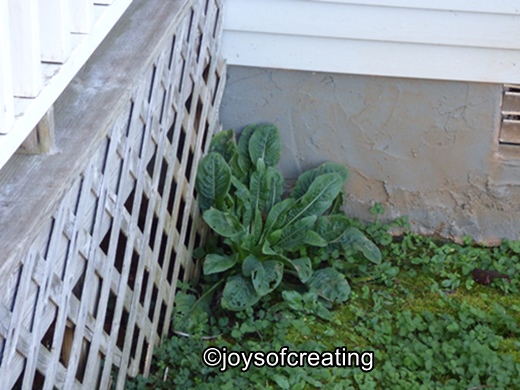 You may wonder what it is about the plant that has interested us so. The thing about this plant is that I believe it to be an 8 o’clock (a variety of evening primrose, king’s cure-all, fever plant).
Over a decade ago, we raised some 8 o’clocks for a couple of seasons. We had to stop because of Japanese Beetles. Those evil little bugs infested our patch of 8 o’clocks like a plague. It was horrid. And of course, they didn’t stop with the 8 o’clocks, they ate our corn in the garden and our roses too.
So, sadly we dug up the 8 o’clocks and bagged them up and tossed them in the local convenience center.
It solved the Japanese beetle problem. We had very few japanese beetles from then on.
If the plant growing in the corner is in fact an 8 o’clock, then the seed would have had to have been lying there buried deep enough to be dormant for around 13 years. Amazing, it is.
8 o’clocks are biennial, so if it survives the winter, it should grow a stalk and bloom next year.
Okay, now for the coolest part about an 8 o’clcok.
The part that I absolutely go silly for…
At 8 o’clock in the evening you can watch the bloom pods begin to move and then burst open in full bloom. (Okay, ours was more of an 8:15 o’clock,) but each evening you could see us sitting outside in the flower bed staring at the buds. It was one of the coolest things, almost magical. The blooms close when the morning comes.
My photo of the blooms is from 2004, it’s the only good photo of the 8 o’clocks I have. I had a small digital camera back then and I wasn’t very efficient at using it.
Now I have a better camera, so I hope that the green plant is an 8 o’clock. I would love to set up my camera and make a movie of it as it bursts open in bloom.
I’m looking forward to next year and seeing if the green plant in the corner is an 8 o’clock.
Have you ever watched a flower bloom in real time?
.

